Showing posts with label essays. Show all posts

Wednesday, June 20, 2012

"An American Childhood" by Annie Dillard

"It was an immense discovery, pounding into my hot head with every sliding, joyous step, that this ordinary adult evidently knew what I thought only children who trained at football knew: that you have to fling yourself at what you're doing, you have to point yourself, forget yourself, aim, dive." (47)


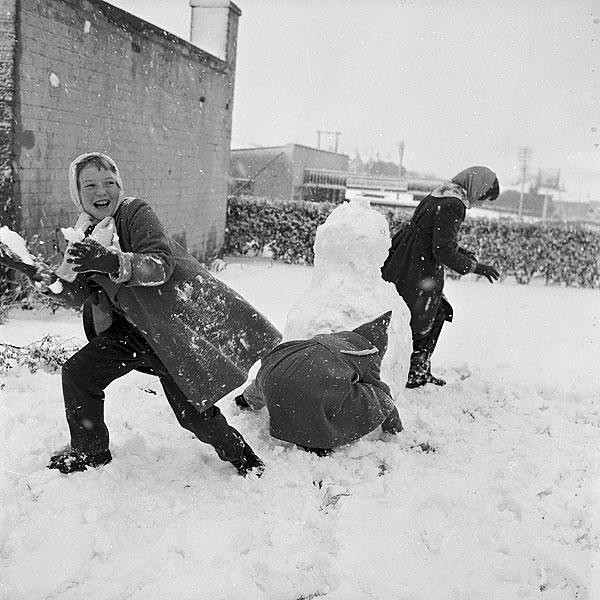
Re-typing Dillard's line immediately put this song in my head. It was this moment in An American Childhood that convinced me I really liked the book. She's describing being chased through the 1950s Pittsburgh after hitting the windshield of a black Buick with a soft snowball, "right before the driver's face". Her anecdote contains none of the conventional judgment you might expect: We should have been more careful, or, perhaps more satisfying, It felt good to be bad. 

The driver chases Dillard and her friend, Mikey, "silently over picket fences, through thorny hedges, between houses, around garbage cans, and across streets". He never quits. 

He catches them, but it doesn't really matter. All he can say is, "You stupid kids". 

The chase was the thing, the process. "The point was that he had chased us passionately without giving up, and so he had caught us. Now he came down to earth. I wanted the glory to last forever".


P.S. Another favorite line from later in the book. Dillard describes her teenage encounter with Giacometti's "Man Walking". "Artists, for their part, noticed the things that engaged the mind's private and idiosyncratic interior, that area where the life of the senses mingles with the life of the spirit: the shattering of life into color, and the way it shades off a round bend. The humble attention painters gave to the shadow of a stalk, or the reflected sheen under a chin, or the lapping layers of long strokes, included and extended the scientists' vision of each least thing as unendingly interesting. But artists laid down the vision in the form of beauty bare—Man Walking—radiant and fierce, inexplicable, and without the math" (213). 

Saturday, June 16, 2012

"Unknown Bards" by John Jeremiah Sullivan

"Part of hearing the blues is taking away the sociological filter, which with good but misguided intentions we allow to develop before our senses..." (270)


The first book I read after completing my M.F.A. in fiction was nonfiction, a collection of essays called Pulphead by John Jeremiah Sullivan. You might have heard of it. It's been pretty popular. And it's good, the kind of reading you can do outside and still feel intellectually stimulated. It's 365 pages of keeping company with someone entertaining and smart who knows way more than you about things like animal attacks, One Tree Hill, Michael Jackson, Christian Rock, and mysterious blues legends.

But what really stuck with me were two rather unassuming quotes buried in the essay "Unknown Bards". The first is above. Here's the other: "We have to go against our training and suspend anthropological thinking here; it doesn't serve at these strata" (275).

Sullivan's larger exploration is of two books (Elijah Wald's Escaping the Delta: Robert Johnson and the Invention of Blues and Marybeth Hamilton's In Search of the Blues: The White Invention of Black Music) that acknowledge and discuss the "baroque aestheticization of early black Southern music by white men" (Sullivan, 268). Within the essay these snippets remind us that jumping to conclusions about art, aiming to categorize it, can lead to a very problematic fetishism, but I held onto them because they remind me how essential first responses are to my experience of literature. When I go after a piece with my craft filter (i.e. how is this working? what is the writer doing here?) first, there's no point. I'm not allowing the piece to simply be what it is; it will leave me cold. But if I turn the filter off to begin and allow my senses to develop first, if the work is good, I'll get to that higher strata.